Global web icon
masterorganicchemistry.com
https://www.masterorganicchemistry.com/2013/03/15/…
Bromination of Alkenes - The Mechanism – Master Organic Chemistry
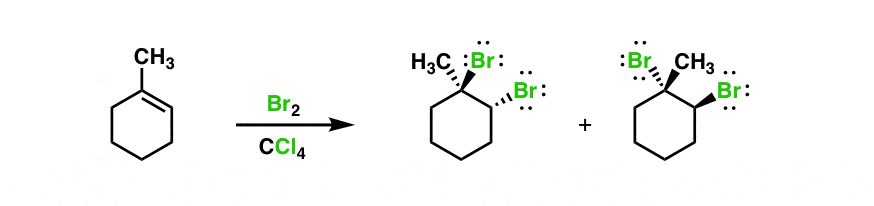
Halogenation of alkenes is an example of a stereoselective reaction. The reaction of Br 2, Cl 2 and other halogens with alkenes leads to products of anti – addition.
Global web icon
libretexts.org
https://chem.libretexts.org/Bookshelves/Organic_Ch…
13.4: The Mechanism of Halogenation - Chemistry LibreTexts
One of these reactions is halogenation, or the substitution of a single hydrogen on the alkane for a single halogen to form a haloalkane. This reaction is very important in organic chemistry because it opens a gateway to further chemical reactions.
Global web icon
chemistrylearner.com
https://www.chemistrylearner.com/halogenation.html
Halogenation: Definition, Examples, and Mechanism
What is halogenation reaction. Check out a few types and examples, along with the reaction mechanism.
Global web icon
chemistrysteps.com
https://www.chemistrysteps.com/halogenation-of-alk…
Halogenation of Alkenes - Chemistry Steps
Draw a mechanism for each reaction to explain the difference when the following alkenes are reacted with bromine. Hint: drawing the chair conformations will be very helpful.
Global web icon
wikipedia.org
https://en.wikipedia.org/wiki/Halogenation
Halogenation - Wikipedia
Several pathways exist for the halogenation of organic compounds, including free radical halogenation, ketone halogenation, electrophilic halogenation, and halogen addition reaction. The nature of the substrate determines the pathway. The facility of halogenation is influenced by the halogen.
Global web icon
pressbooks.pub
https://ecampusontario.pressbooks.pub/mcmasterchem…
3.2.4 – Halogenation of Alkenes – Organic Chemistry and Chemical ...
A halogenation addition reaction occurs between halogens (Br 2 and Cl 2) and alkenes, creating two adjacent C­X bonds, where X is a halogen (Br or Cl). For example, bromination adds one bromine atom to each alkene carbon, resulting in a dibromoalkane.
Global web icon
chemistrytalk.org
https://chemistrytalk.org/what-is-halogenation/
What is Halogenation? - ChemTalk
Free radical halogenation reactions are substitution reactions that involve the replacement of hydrogen atoms by halogen atoms in saturated hydrocarbons, otherwise known as alkanes. The reaction mechanism consists of three steps which are chain initiation, chain propagation, and chain termination.
Global web icon
geeksforgeeks.org
https://www.geeksforgeeks.org/chemistry/halogenati…
Halogenation - GeeksforGeeks
The reaction can occur through free radical halogenation, initiated by heat or light, and proceeds through a chain reaction mechanism involving initiation, propagation, and termination steps.
Global web icon
lumenlearning.com
https://courses.lumenlearning.com/suny-mcc-organic…
Halogenation of Alkenes | MCC Organic Chemistry - Lumen Learning
As halogen molecule, for example Br 2, approaches a double bond of the alkene, electrons in the double bond repel electrons in bromine molecule causing polarization of the halogen bond. This creates a dipolar moment in the halogen molecule bond.
Global web icon
libretexts.org
https://chem.libretexts.org/Bookshelves/Organic_Ch…
8.2: Halogenation of Alkenes - Addition of X₂ - Chemistry LibreTexts
Electrophilic addition mechanism consists of two steps. Before constructing the mechanism let us summarize conditions for this reaction. We will use Br 2 in our example for halogenation of ethylene.