Data compressionalgorithms present a space–time complexity trade-off between the bytes needed to store or transmit information, and the computational resources needed to perform the encoding and decoding.
A comprehensive and interactive cheatsheet for Data Compressionalgorithms. Explore lossless (Huffman, LZW, Zstd) and lossy (JPEG, MP3, H.264) techniques, theory, practical tips, and evaluation metrics.
Compressiontechniques are useful for reducing file sizes for storage, minimizing bandwidth during transmission and enabling faster uploading/downloading of web content over the internet. Data compression can be divided into two categories: lossless and lossy.
Compressionalgorithms in two-way communication have unique requirements such as low latency, high compression ratio, and the ability to handle variable bit rates. These requirements are necessary to ensure efficient communication between two parties.
Ever wondered how to shrink your files to an impossibly small size? You’re in the right place! This is your ultimate guide to the wild world of compressionalgorithms.
Data compressionalgorithms are a fundamental aspect of computer science and play a crucial role in our digital world. As a developer, understanding these algorithms can significantly enhance your ability to handle data efficiently, optimize storage, and improve application performance.
Understand CompressionAlgorithms, its Types, List, and Working. Learn how this reduce data size, their applications, and how they function effectively.
This article dives into the mathematical foundations and mechanisms of various data compressionalgorithms, both lossless and lossy, and explores their real-world applications.
The three most common compression programs for general data are Zip (on computers using Windows operating system), StuffIt (on Apple computers), and gzip (on computers running UNIX); all use lossless compression.
In this article, you will discover six different types of lossless data compressionalgorithms, and four image and video compressionalgorithms based on deep learning.
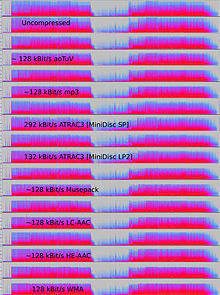 Data compression algorithms present a space–time complexity trade-off between the bytes needed to store or transmit information, and the computational resources needed to perform the encoding and decoding.